Boots on the Ground at Home: Farms Work for Conservation and Healthy Humans Too
April 20, 2026
Farmers in western Colorado are preparing to plant their fields. Most are glad to see some moisture, but no one is pretending it will be enough. April 1, when it should be at its peak, saw the snowpack in the Gunnison River Basin under 15% of the median for that date. Everyone is aware that six other states, millions downstream, all have their eyes on the Western Slope's water.
Soil is where farming starts. Along with sun, work and rain, those four things are what all agriculture relies on. But it is in the soil where it all comes together. And soil is living. When full of organic material - soil is like a sponge. According to the U.S. Department of Agriculture (USDA), just one percent of organic matter in the top six inches of soil can hold roughly 27,000 gallons of water per acre.
The USDA agency that works with farmers to protect healthy and productive soils is the Natural Resources Conservation Service (NRCS). And recently more than 500 farmers and ranchers urged Congressional leaders to prioritize funding and staffing for NRCS, which delivers conservation programs like EQIP (Environmental Quality Incentives Program) to America’s growers.
Because soil is not just dirt. A small scoop of healthy soil contains more microbial organisms than there are humans on Earth — bacteria, fungi, protozoa, nematodes, arthropods, earthworms. Soil is an ecosystem. And soil function depends on its health.
Practices such as cover cropping, returning organic material back into the ground, reducing tillage, and agroforestry can all rebuild soil structure and microbial networks, increasing infiltration and water retention. This is particularly critical in arid places like the U.S. Southwest, including the Gunnison Basin, where rainfall is often intense but short-lived. When soils are alive, water infiltrates. When soils are dead, it runs off.
Soil is good for life. For plants that grow and the animals that feed. And for the soil life that plays a critical role in plant development by cycling nutrients. Healthy soil enhances plant stress tolerance and adaptability. It also shapes the composition of plant-associated microbiotics all the way into our stomachs, via that summer peach or other farm-stand favorite. Communities of microbes that colonize plants we eat, or that our food eats, influence our gut health too.
Biologically diverse soil also provides system resilience. Healthy soil has lots of organisms cycling nutrients and moving matter and energy. The worst-positioned soils are in already-hot, already-stressed landscapes. This is exactly where much of the Mountain West sits, or can be a buffer against. Investment in soil health isn't just about farm productivity. It's that healthy soil is a form of insurance against the instability that's coming – to downstream users and to our own health and systems upstream too.
So, yes, healthy soil grows healthy food for healthy people. It helps our own gut biome and it also helps to guard against drought. The good news is that soil conservation and building soil health, and thus system health including our own, is not necessarily complicated work. A lot of it can be pretty routine. But it is work. It takes investment, money and labor. And it requires people walking in the field - farmers, advisors, workers - boots out on the ground.
Farming is place-based work. The agencies that serve farmers have often also been so, in rural places across America. Farmers are walking ditches now, as the irrigation season starts, and are looking at the crisis bearing down on the Colorado River and its major tributaries, including the Gunnison Basin and the North Fork Valley.
The too late fresh snowfall in the mountains is unlikely to be near enough. Hope turns to talk of a building El Niño, and to a warming Sea of Cortez pushing stronger monsoonal moisture into the Southwest this summer - which is when people are expecting major irrigation systems in the North Fork Valley, in the Gunnison Basin, to go dry.
Soil matters to farms. It is what brings it all together. In a healthy system, water and soil work together. Regenerative agriculture is about building up organic material in soil that relies on things to grow as well - water, nutrients, energy including sun, and the labor of life, of soil biota, cycling all that. Healthy soils benefit crop production and farm prosperity. They are also good for watershed resilience. That’s good for water users upstream, and downstream too.
But soil health takes boots on the ground. Farming requires work. And farm agency staffing cuts do hurt, as this recent blog from the National Sustainable Agriculture Coalition details. So now, when a North Fork farmer shows up at the Delta County NRCS office they might find a locked door. According to a recent analysis by Prospect Partners, and county-level data shared by the National Sustainable Agriculture Coalition, western Colorado has been hit hard by NRCS staff cuts.
Sourced from the U.S. Office of Personnel Management – the federal government’s HR agency, the data show that Delta County’s NRCS staff were slashed by two‑thirds, from six down to two. Gunnison County saw a nearly 50% reduction in staff, from five to three.
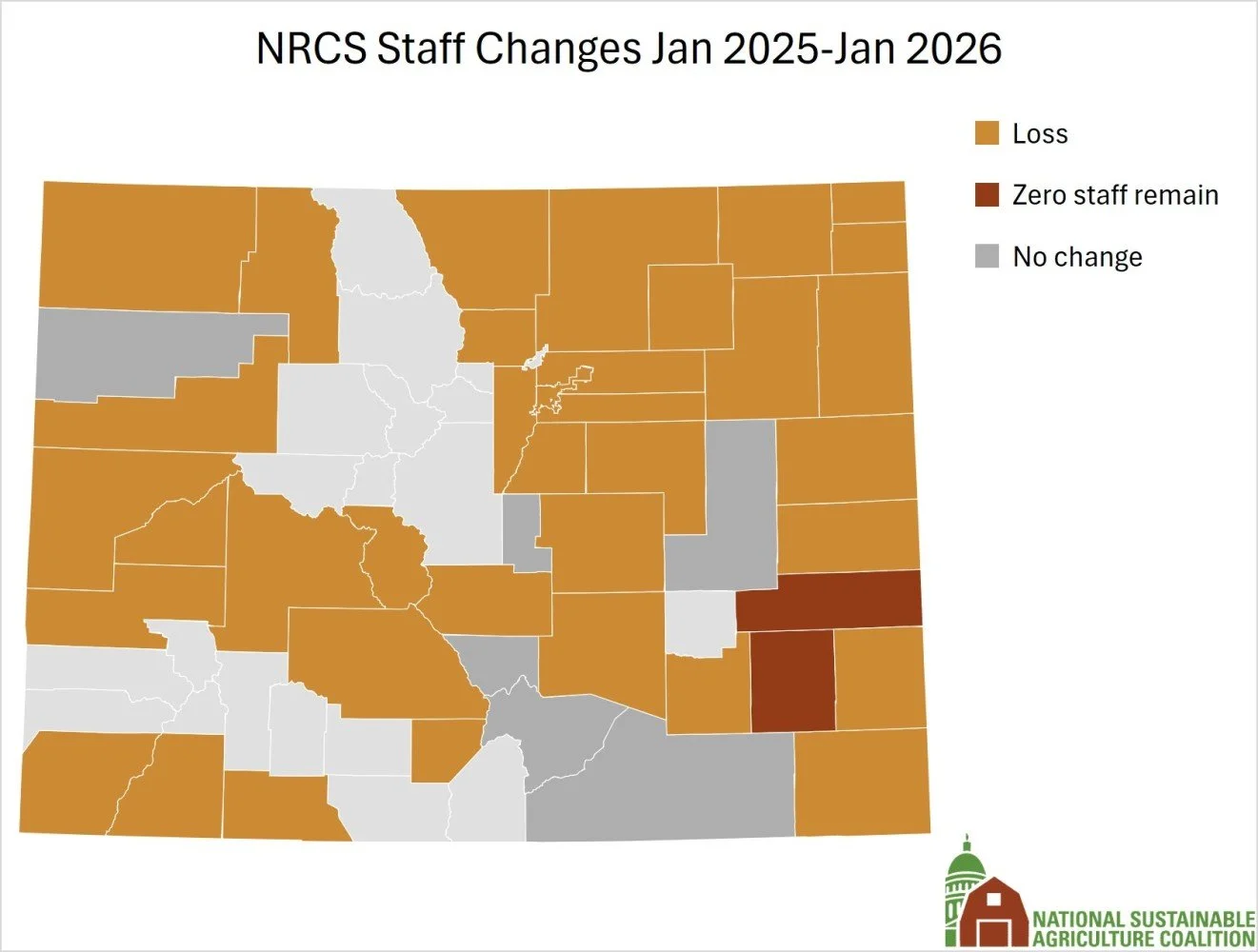
Most Colorado counties that had U.S. Natural Resources Conservation Service offices in 2025 lost staff by January 2026.
Mesa County lost half its NRCS staff, even though that office is supposed to handle several counties, including new loads from places such as Delta County. Montrose lost 60% of its staff, according to the analysis, from 10 to four. Like Grand Junction it too is supposed to be an office that serves a region - not a single county. Fewer staff. Fewer hours. Fewer boots on the ground.
At the season when farmers are planting their fields, looking at a dire water year, and aware that the thirst is growing too from others who also rely on resilient and healthy headwaters up here - these staffing cuts hit hard.
Soil is not just dirt. Nor is it partisan and political. And soil can be a solution. But it takes boots on the ground, and successful farmers, here at home.